
PDK Gearbox Maintenance: What Every Porsche Owner Needs to Know

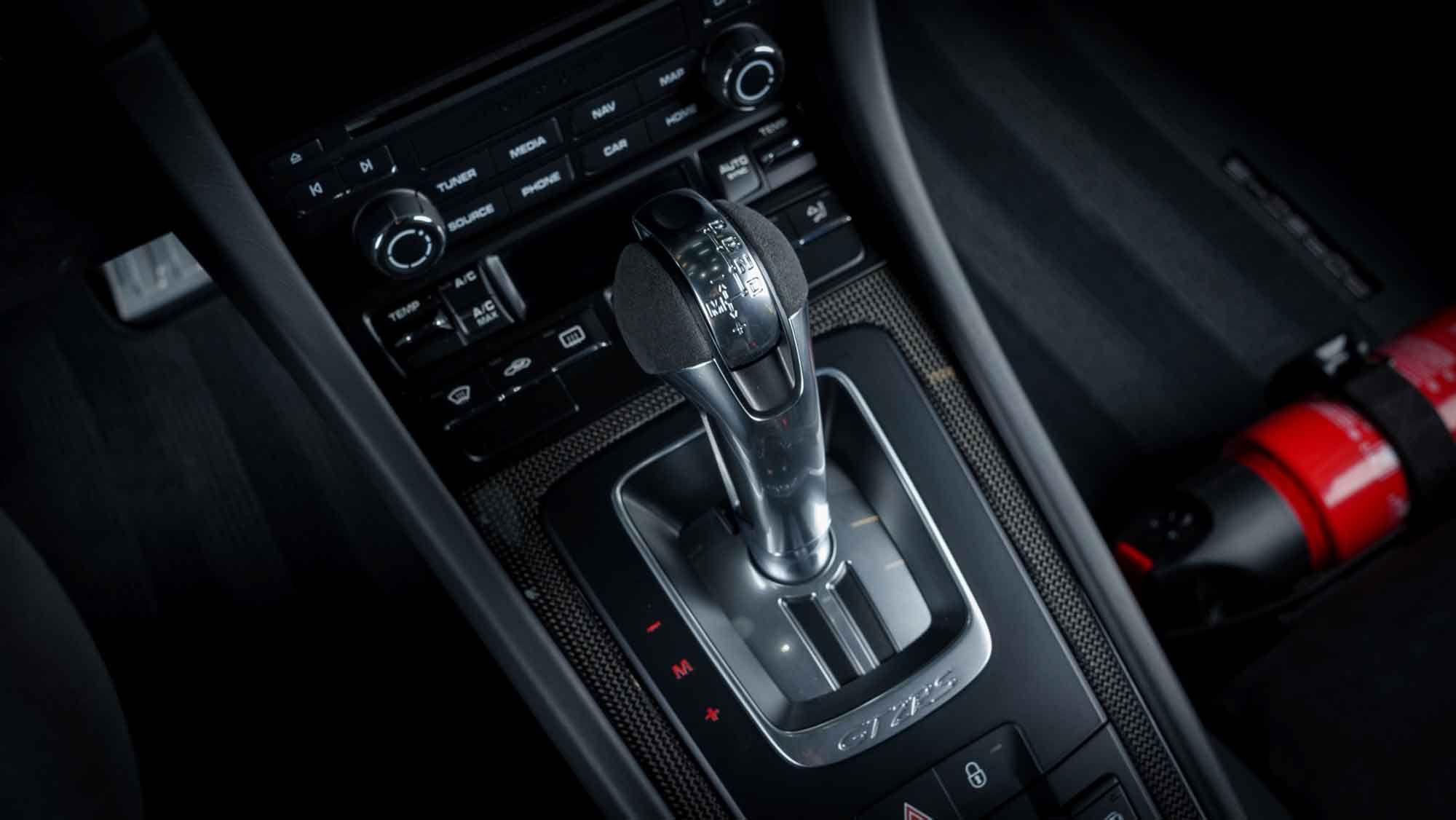
PDK gearbox maintenance comes down to three things: changing the gearbox oil when Porsche’s maintenance schedule says it’s due, checking the gearbox electronics with Porsche diagnostics, and acting early on any change in how the car shifts. PDK is a strong, well-proven gearbox, but it isn’t maintenance-free.
In short: PDK (Porsche Doppelkupplung) is Porsche’s dual-clutch gearbox, fitted to the 911 from the 997.2, the Boxster and Cayman from the 987.2, the Macan and most Panameras. PDK gearbox maintenance means changing its oil when Porsche’s maintenance schedule requires, reading the gearbox control unit with PIWIS, checking for leaks and investigating any change in shift quality promptly.
What is a PDK gearbox?
PDK is Porsche’s dual-clutch gearbox. The name is short for Porsche Doppelkupplung, German for “double clutch”. Inside, it works like two manual gearboxes sharing one casing: one clutch looks after the odd-numbered gears and the other the even-numbered ones. While you’re in one gear the next is already selected, so a change is a handover from one clutch to the other, with no break in drive.
The clutches are wet multi-plate clutches, running in oil that cools them. Porsche developed the idea on its racing cars in the 1980s and brought it to road cars with the 997.2 911 in 2008. In everyday driving a PDK car behaves much like an automatic, creeping forward when you come off the brake, with manual changes available through the steering-wheel controls or the selector.
Which Porsches have a PDK gearbox?
PDK is fitted to the 911 from the 997.2 onwards, the Boxster and Cayman from the 987.2 onwards, every petrol and diesel Macan, and most Panameras. On the 911, Boxster and Cayman it was usually an option alongside a manual gearbox, so not every car from those generations has one.
| Model | Generations with PDK | Notes |
|---|---|---|
| 911 | 997.2 and 991 | An option on most models, standard on some |
| Boxster and Cayman | 987.2, 981 and 718 | An option alongside the manual on most models |
| Macan | All petrol and diesel models | PDK on every car |
| Panamera | Most versions | The usual gearbox from launch |
| Cayenne | None | Automatic Cayennes use Tiptronic |
Before PDK, automatic 911s, Boxsters and Caymans (the 996, 997.1, 986 and 987.1) used Tiptronic, a conventional automatic with a torque converter. Automatic Cayennes use Tiptronic too, so the Cayenne isn’t a PDK car. The switch to PDK was one of the bigger changes between the 997.1 and 997.2.
Does a PDK gearbox need servicing?
Yes. PDK oil changes appear in Porsche’s maintenance schedules, and the interval varies by model and year, so the right answer for your car is in its own schedule rather than a general rule.
You’ll sometimes hear PDK oil described as “filled for life”. We wouldn’t treat it that way. The clutches run in that oil and it carries their heat away, so it works hard, and leaving it past its change point is a false economy on a gearbox that’s expensive to repair. PDK oil changes are part of following Porsche’s schedule at a Porsche service.
Two oil circuits, not one
A PDK gearbox has two separate oil circuits. The clutches run in their own oil, separate from the oil that lubricates the gear set. When you’re comparing quotes for a “PDK oil change”, ask which oil is included, and check that the work follows Porsche’s procedure for that gearbox.
Why the procedure matters
On modern automatic and dual-clutch gearboxes, the oil level is usually set with the gearbox at a specified temperature, read through the diagnostic system. Getting the level wrong in either direction can affect how the gearbox behaves, so this is a job for a workshop with Porsche diagnostics rather than a simple drain and refill.
What are the signs of a PDK problem?
The usual sign of a PDK problem is a change in how the car drives: shifts that feel rougher or slower than they used to, or low-speed behaviour that isn’t as smooth as it was. Things to watch for:
- Judder or jerkiness when pulling away or manoeuvring
- Gear changes that take longer, or arrive with a thump
- A delay engaging drive or reverse
- Revs flaring between gears, or a feeling of slip
- A gearbox warning on the dashboard, or the car dropping into a reduced emergency mode
- New whining or clunking noises
- Oil marks under the car
None of these automatically means a major failure. A weak battery, a fault elsewhere in the car or the gearbox software can produce similar symptoms, which is why proper diagnosis comes before any decision about repairs.
How does a specialist carry out PDK gearbox maintenance?
A specialist starts by reading the gearbox control unit with Porsche diagnostic equipment, then checks for leaks, changes whichever oil the schedule calls for using the correct procedure, and finishes with a road test. At our High Wycombe workshop, the diagnostic side is done on PIWIS 4.
- Read the gearbox control unit. Fault codes and stored data can show problems the driver hasn’t noticed yet.
- Inspect. Look for leaks from the gearbox and its seals, and check the battery and charging system, because low voltage can set faults in several control units at once.
- Change the oil when it’s due, following Porsche’s fill and level procedure for that gearbox.
- Consider software. Porsche issues updates for many of its control units, and some are only available through a Porsche Centre, so it can be worth asking one whether an update applies to your car.
- Road test from cold and when warm, at low speed and under load, in both automatic and manual modes.
If the diagnosis points to a mechanical fault rather than a servicing matter, our page on Porsche engine and gearbox rebuilds covers that side of our work.
How can you look after a PDK gearbox day to day?
Drive it normally and keep up with the schedule. PDK doesn’t need special treatment, but a few habits help it last:
- Hold the car on the brake, not the throttle. Holding a PDK car on a slope with the throttle slips the clutch and builds heat.
- Go easy on launch control. Repeated launch-control starts put a lot of heat and load through the clutches.
- Let it warm up before driving hard.
- Look after the battery, especially if the car is laid up. Low voltage can cause odd behaviour and fault codes.
- Act on changes early. A shift that feels different is worth checking before it becomes a repair.
If you’re buying a PDK car, ask when its oil was last changed and have the gearbox read as part of a pre-purchase inspection. Our buying guides to the 997.2 and the 987 Boxster and Cayman cover the rest of the car, and our guide to Porsche service costs explains how a service that includes PDK oil is priced.
Common questions
Is PDK oil lifetime fill?
No. PDK oil changes appear in Porsche’s maintenance schedules, with the interval depending on the model and year. Check the schedule for your car, or ask us and we’ll tell you what’s due.
How often should PDK oil be changed?
Follow Porsche’s maintenance schedule for your model and year; there isn’t a single figure that applies to every PDK car. If the service history doesn’t show the PDK oil being changed when it fell due, have it done and the gearbox checked.
Does the Porsche Cayenne have a PDK gearbox?
No. Automatic Cayennes use Tiptronic, a conventional automatic gearbox with a torque converter, rather than PDK. Its maintenance follows the Cayenne’s own schedule.
Is PDK the same as Tiptronic?
No. Tiptronic is Porsche’s torque-converter automatic, used in the 911, Boxster and Cayman before PDK arrived and still used in the Cayenne. PDK is a dual-clutch gearbox, with two wet clutches in place of the torque converter.
Getting your PDK checked
If your PDK has started to feel different, or you’re not sure when its oil was last changed, we can read the gearbox with PIWIS 4 and tell you what Porsche’s schedule says is due. The car comes to our workshop in High Wycombe, and collection and delivery is available for London clients. Find out more about our Porsche servicing, or contact us by phone or email to book.
More on these models: Porsche 911, Porsche Boxster & Cayman, Porsche Macan and Porsche Panamera.